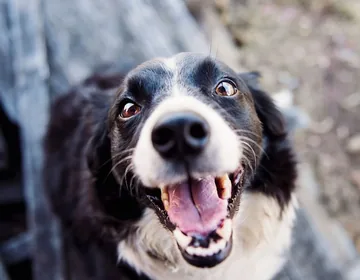
From the tiny Yorkshire Terrier to the giant Irish Wolfhound, the variety between dog breeds seems almost endless. These extreme physical differences can make it hard to believe that all breeds are the same species. This, on top of the behavioral differences between breeds as well. For example, terriers tend to be feisty and energetic whereas scenthounds are usually loyal and ruled by their noses. But is brain size among these differences? Research has found that not only are dog’s brains different sizes, but their brain size affects how trainable they are.
In This Article
Do Different Dog Breeds Have Different Relative Brain Sizes?
There are several ways of measuring an animal’s brain. One is the absolute size of the brain — its mass or volume. Another measure is the brain size relative to body size. In other words, the size of the brain divided by the size of the body. This relative measurement is used to look at the fossil record and study how brains have evolved over time. It’s also a measure that scales to body size. As bodies get bigger, so do their brains.
However, sometimes an animal has a higher relative brain size than expected for their body size, a feature that is potentially associated with a greater capacity for information processing. Throughout evolution, higher relative brain size has been associated with more complex cognitive skills. But within the single dog species (Canis familiaris), there are so many breeds of different sizes and different skills.
How Do Dogs’ Brains Compare to Wolves’?
Dr. Ana M. Balcarcel of The Institute of Evolutionary Science at the University of Montpellier and her team wanted to investigate how much relative brain size varied across different dog breeds, and if this was connected to their different behaviors and abilities.
She explains that we’ve known for over a century that the relative brain size of dogs is at least 20% smaller than that of the gray wolf, dogs’ closest wild relative. But some dog breeds have shown high cognitive skills, like following human pointing gestures, that exceed those of wolves. In addition, there’s a history of dogs being bred for a variety of specializations. “My question was whether these dogs that have different functions and that have been bred for so many different things, some quite skilled and more cooperative than others, do these behaviors or specializations correlate with their relative brain size.”
Relative Brain to Body Size
Dr. Balcarcel’s team measured the endocranial volume (space inside the skull that would house the brain) of 1,682 adult dog skulls held in the collection of the Natural History Museum in Bern, Switzerland. Endocranial volume was used as a placeholder for brain size. There were an almost equal number of male and female skull samples, and 172 breeds were represented. Using the AKC’s body mass averages, the scientists were able to calculate the relative brain size for each of the tested breeds.
Next, the team looked at the behavioral traits of each breed using the Canine Behavioral Assessment and Research Questionnaire (C-BARQ). The C-BARQ is a database housed at the University of Pennsylvania that contains detailed evaluations from approximately 50,000 pet dogs, including more than 300 different breeds. It provided Dr. Balcarcel with information on breed traits such as trainability, attention-seeking, energy level, fear, and aggression.
Smaller Dogs Have Larger Relative Brain Sizes
When the scientists grouped the breeds by traditional function using the AKC’s breed groups, they made a surprising discovery. Normally you would expect to see a similar relationship between brain size and body size in a single species. But that wasn’t the case for dogs. Dr. Balcarcel says, “The little dogs, like the toy dogs, have the largest relative brain size. Then, there was a spectrum to the largest dogs that have the smallest relative brain size. So the larger dogs’ bodies are a bit bigger than you would expect for the size of their brains.”
According to Dr. Balcarcel, that really highlights how much humans have changed the proportions of dogs’ brains and bodies through breeding programs. It’s not that people were selecting for big brains or small brains. But by wanting dogs that are tiny and cute, we’ve changed what we would otherwise see in nature. And although most breeds are relatively recent inventions, as far back as several thousand years ago, we see dogs of different sizes in the archaeological record.
Links Between Relative Brain Size
Larger Dogs with Smaller Relative Brain Size
When the scientists compared relative brain size to the C-BARQ behaviors, they found another surprising result. The larger dogs with their smaller relative brain sizes showed the greatest trainability, often seen as a measure of cognitive sophistication. When you look at the Working Group specifically, these dogs were bred to work cooperatively with humans as police dogs, bomb detection dogs, and so on. Studies have shown they have additional cognitive skills such as better decision-making and short-term memory, which goes to show that the relative brain size measurement that Dr. Balcarcel’s team calculated doesn’t predict cognitive ability in dogs as it does in other animals.
Smaller Dogs with Larger Relative Brain Size
In addition, the small dogs with their larger relative brain size had more fearfulness, aggression, attention-seeking, and separation anxiety than the larger dogs. Perhaps during breed development, these traits weren’t disadvantageous in these breeds as they would’ve been in the larger working dogs. As Dr. Balcarcel says, we’ve been training dogs in certain ways for hundreds of years and that has become part of each breed’s typical behavior. These traits have evolved in certain types of dogs thanks to our artificial selection.
What Relative Brain Size Really Means
In Dr. Balcarcel’s opinion, these smaller dogs don’t have the same cognitive skills as the larger working dogs. They were bred to be companions rather than guarding, herding, or hunting dogs. But when it comes down to it, your dog’s relative brain size doesn’t matter. Every dog has a wonderful set of skills, whether that’s trainability or companionship.
Plus, the AKC’s recent versatility study shows that a variety of dog breeds can be successful learning multiple sports activities, no matter the brain size. Dr. Balcarcel’s dog was a Pomeranian, and when asked if relative brain size should be of concern, she replied, “I didn’t care if my little dog had particularly bad short-term memory. He loved cuddles. He was a fantastic companion. No need to worry about it at all.”
Key Takeaways
- Relative brain size varies significantly among dog breeds.
- Small breeds tend to have larger brains relative to their body size than large breeds.
- Larger working breeds often score higher for trainability despite having smaller relative brain sizes.
- Relative brain size does not appear to predict trainability or cognitive ability in dogs.
- Breed history and selective breeding likely play a greater role in behavior than brain size alone.
Frequently Asked Questions
-
Does a dog's brain size affect trainability?
+
Research suggests relative brain size does not directly predict trainability in dogs. Larger working breeds often score higher for trainability despite having smaller brains relative to their body size.
-
Do small dogs have larger brains than big dogs?
+
Not in absolute size. However, small breeds often have larger brains relative to their body size, while larger breeds tend to have smaller relative brain sizes.
-
Are larger dogs easier to train than smaller dogs?
+
Some larger working breeds tend to score higher for trainability in behavioral studies, but trainability varies by breed, genetics, individual temperament, and training experience.
-
How do researchers measure brain size in dogs?
+
Researchers often measure endocranial volume, which is the space inside the skull that houses the brain. They can then compare brain size to body size to calculate relative brain size.
-
Does a larger brain mean a smarter dog?
+
Not necessarily. This study found that relative brain size did not predict trainability or cognitive ability in dogs. Breed purpose, selective breeding, and individual characteristics appear to be more important factors.
Source: AKC Expert Advice